Home/Projects/Women Able to Change Society
Women Able to Change Society
Five years of women's leadership across four governorates.
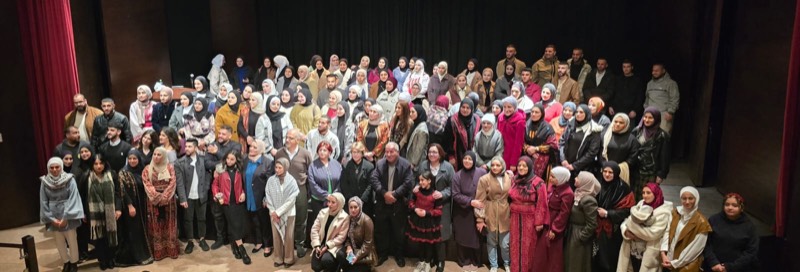
Closing conference, Women Able to Change Society · Ramallah, 2024 — © HDIP · Photography & credits
At a glance
Over five years the project was implemented in four main West Bank governorates. It targeted women and youth aged 18 to 30 — university students, graduates and homemakers. In each governorate 35 trainees took part, working with 16 sites (a village or town each), with one trainee selected from every site to act as a link to the women's groups in her area.
At a glance
Completed · 2020–2024- GovernoratesHebron, Jenin, Tulkarm, Ramallah
- Target groupWomen and youth aged 18–30
- Trainees35 per governorate
- Sites16 per governorate
- PartnerOlof Palme International Center
Objectives
- Raise awareness of women's rights and the importance of their participation in local elections.
- Deliver comprehensive training in feminist leadership, political participation, gender equality and human rights.
- Build knowledge of the family protection law and the principles of non-violence.
- Equip women to express themselves and defend their rights, increasing their opportunity to stand in local elections.
- Create spaces where women can bring their issues directly to decision-makers.
Activities and outputs
- Training in 2024The project continued delivering training through 2024, with trainees receiving further sessions in feminist leadership, gender and non-violence.
- Coalition building10 coalition-building meetings for 30 participants, identifying shared goals and issues including discussion of the family protection law. A training seminar was also held in Ramallah for 52 participants, allowing exchange of experience and strengthening of skills.
- Closing conferenceA closing conference was held in Ramallah where more than 200 women and men met decision-makers. The conference gave women a platform to raise their issues and experiences, contributing significantly to their empowerment and to strengthening their participation in political and social life.
- Success storiesAt the closing conference women told their own success stories — demonstrating their ability to share their experience and to invite other women to take part, reflecting the behavioural change and positive impact of the training and empowerment programmes.
Results · 2025 / 2024
Economic empowerment, employment for displaced women, and psychosocial support.
The 2025 phase added an economic strand, "Skill and Idea", and responded to displacement in Jenin and Tulkarm by creating paid work for displaced women running children's camps.
- 100 participants trained in advanced beauty and personal care, digital marketing, photography and design, with workshops on advocacy, social justice and gender equality.
- 5 product marketing exhibitions involving 100 beneficiaries (70 women, 30 men), creating direct marketing opportunities and links to civil society and decision-makers.
- 14 displaced women employed across a summer camp reaching 160 participants and a winter camp reaching 220.
- A three-day evaluation and psychosocial support workshop — 25 sessions for 25 women, using mindfulness, reflective writing and drawing.
- A three-day winter mental health camp for 25 women from marginalised and displaced communities.
- 3 alliance-building activities with 20 local leaders, and 4 roundtables with 40 civil society representatives and decision-makers.
- 10 further alliance-building meetings reaching 30 participants, and a concluding training seminar in Ramallah for 52 participants.
Results reported for 2024.
- A marked change in women's behaviour and self-confidence between the start and the end of the project.
- At the outset many women had low self-confidence, which limited their participation in social and political activity.
- There was a significant gap in awareness of their legal and social rights, leaving them hesitant to claim those rights.
- As the project progressed, women became markedly more confident, more ready to express their opinions and to take part in events.
- Awareness of legal and social rights rose, helping them claim those rights more effectively.
Work with this project
HDIP partners with donors, councils and community organisations on delivery, training and evaluation.